EVP, TVP and JVP: how to turn your employer promise into a careers site
Many careers sites tell one story to everyone. A nurse, a data analyst and a graduate read the same text about a great employer with room to grow. The whitepaper "Why employer branding is the driving force behind your business strategy" by Cartel Works describes a way to separate those: three layers in your employer promise. This article shows what the layers are and where they belong on your careers site.
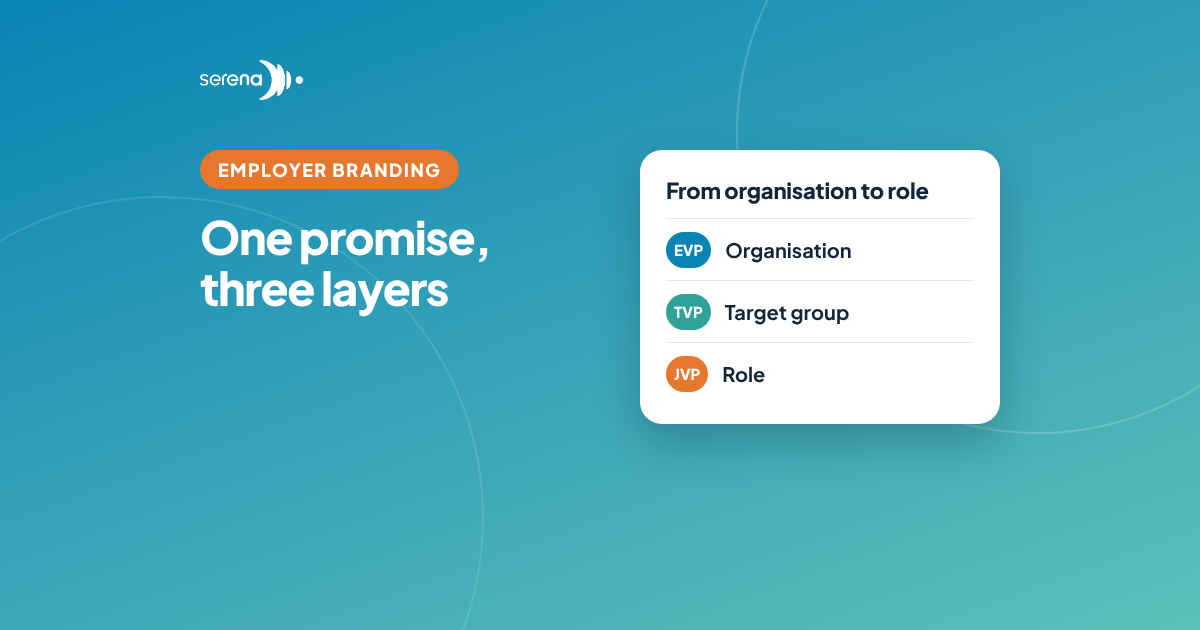
Three layers: EVP, TVP and JVP
The Employer Value Proposition (EVP) is your organisation's promise to all employees and candidates. It says what makes working for you special and why people stay. The paper mentions themes such as culture, career development, work-life balance, leadership and social impact. A slogan will not do, the promise has to be concrete.
The Talent Value Proposition (TVP) translates the EVP for a specific target group, such as IT professionals, nurses or young graduates. It answers what that group is looking for, what motivates it and what puts it off.
The Job Value Proposition (JVP) is the most concrete layer. It describes what makes one role attractive and why this vacancy is a unique opportunity. The JVP takes shape in vacancy texts, job videos and other recruitment channels.
According to the paper, each layer has its own use. You use the EVP in your employer branding, on your career site and in internal communication. You use the TVP for segmentation in campaigns, on the job site and in social posts. You use the JVP in vacancy texts, job videos and job ads.
Where each layer belongs on your careers site
The homepage carries the EVP. It says what your organisation promises to everyone who wants to work for you.
Target group pages carry the TVP. A page for technical staff, healthcare or graduates gets its own promise, its own stories and its own vacancies. How that works for technical audiences is covered in careers sites in technical industries. For blue collar recruitment the promise has to be short and practical.
Vacancy pages carry the JVP. Every vacancy gets a block on what makes this role special compared with similar jobs elsewhere. Honest points belong there. We wrote about that in realistic job preview.
Does your organisation have several brands or countries? Then you put them on one site with the company function, with its own accents in the promise per company.
Why the layers need each other
The paper points out that an EVP has to match the needs of your target groups. If a candidate does not recognise herself in it, the EVP misses its goal. The TVP bridges the broad EVP and targeted communication. Without that layer your site stays generic. Without a JVP a candidate does not know what makes this specific role special.
How to approach it
- Write your EVP in one paragraph and test it with employees.
- Pick two or three target groups you expect most vacancies for.
- Build a page per target group with its own promise, stories and vacancies.
- Give every vacancy a block on what makes the role special.
- Measure per layer: visits per target group page and conversion from vacancy view to application.
In the Serena CMS you build pages freely, with your own house style and CSS, and manage them yourself. For measuring you connect Google Analytics, and in the Advanced package you use the Serena Data Layer. You can read more about what the Serena platform can do on the website. Which KPIs to follow beyond conversion is covered in KPIs beyond time to fill. How the promise ties in with employer branding at an RPO partner is covered in employer branding within RPO. In the case studies you can see how organisations set up their site.
Frequently asked questions
What is the difference between EVP and TVP?
The EVP applies to all employees. The TVP translates that promise for a specific target group, such as IT professionals or nurses.
Do I need all three layers?
If you recruit for one job family, a clear EVP with strong JVPs may be enough. Once you recruit for several target groups, the TVP becomes useful.
Where do I put my EVP on the site?
On the homepage and on the pages about working for your organisation.
How do I measure whether it works?
Look at visits per target group page, conversion from vacancy view to application and the quality of the inflow.
Links
7 links in the text, of which at least 6 to serenacms.com pages.
Open points before publication
- The Cartel Works whitepaper is used as a source, as requested. Figures from the paper (Randstad, McKinsey, Gallup, IDEWE, Vlerick) are taken over from the paper; check them at publication.
- The cases from the paper are not used.
- Links to other blogs point to the slug under /blog/. Update them after publication.
- Serena claims (forms per vacancy, Google 4 Jobs, XML feed, Data Layer) come from the knowledge base; check them at publication.