A careers site strategy in five questions
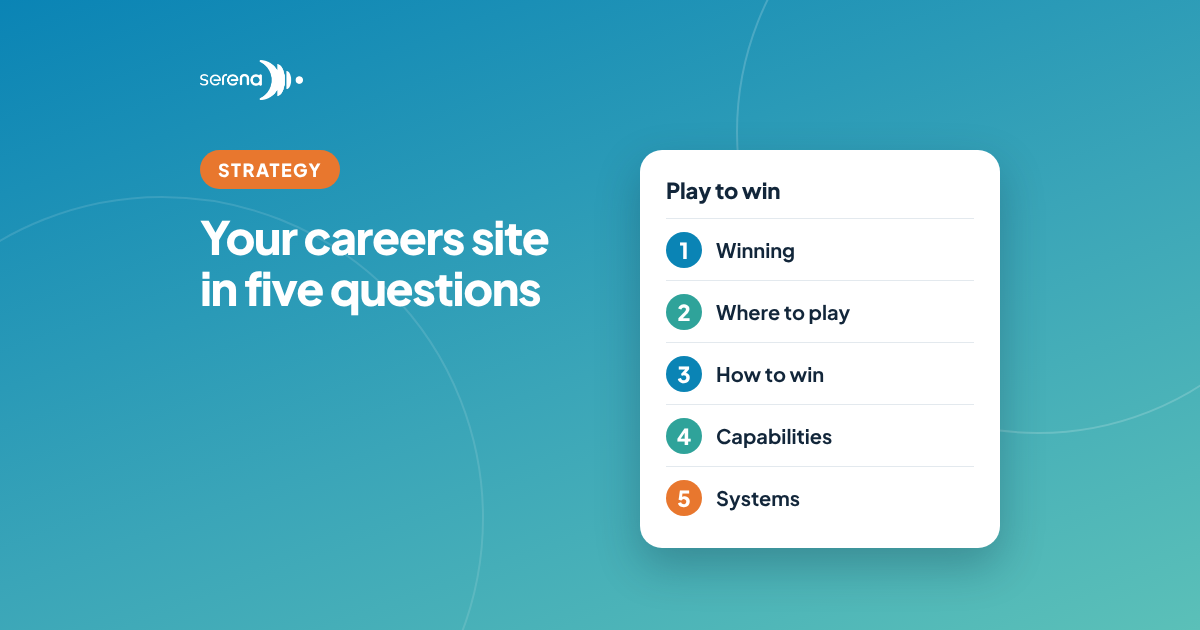
A careers site often starts with a design or with a tool. It makes more sense to start with a strategy. The whitepaper "Why employer branding is the driving force behind your business strategy" by Cartel Works uses the play-to-win framework for this. It consists of five questions. Below you see how to apply them to your careers site.
1. Winning aspiration: what does winning mean for you?
The paper asks for the ultimate goal or vision of success. For a careers site that is a defined result. Think of more suitable candidates for critical roles, less dependence on agencies or a lower cost-per-hire. Add a number and a date, otherwise you cannot test it later. Which measurements fit is covered in KPIs beyond time to fill.
2. Where to play: where do you want to compete?
This is about markets, sectors and customer segments. On your site it turns into choices. Which target groups get their own page? Which brands, countries or languages belong? Someone who wants everything at once builds a site that appeals to nobody. Starting with two or three target groups is more workable. How your promise differs per target group and role is covered in EVP, TVP and JVP.
3. How to win: how do you want to win?
This is about standing out from the competition. What makes working for you different from working for a similar employer in your region? The answer forms the core of your employer promise. To find it you first need insight into target group, market and society. That is what research before you build a careers site covers.
4. Capabilities: which capabilities do you need?
Which skills and resources do you need to carry out the strategy? These are questions about people. Who writes the texts, who manages the pages, who builds campaign pages and who reads the numbers? Managing it yourself in the CMS is one option, a partner or agency another. You can see which partners design and set up Serena sites on the partner overview.
5. Systems: which systems support the strategy?
By this the paper means the processes, structures and tools that let you measure progress and adjust. For your careers site it is the combination of site, ATS and measurement layer. A Serena site integrates with many ATS systems and lets you set up forms per vacancy, see application forms per vacancy. Vacancies reach job boards and Google through Google 4 Jobs and an XML feed. For measurement you connect Google Analytics, and with the Advanced package you use the Serena Data Layer. A change of ATS does not have to touch your site, as one careers site for every ATS shows.
Use the five questions as a brief
Answer the questions in advance on one page. You then have a brief that an agency or internal team can start from. Fill in what you need per question with the Serena platform in mind. You can find an example of an approach in the case studies.
Frequently asked questions
What is the play-to-win framework?
A strategy model with five questions: winning aspiration, where to play, how to win, capabilities and systems. The paper applies it to employer branding.
Do I have to answer all five questions?
Yes, but briefly. The point is to make your choices explicit before you build.
Who answers them?
HR, marketing and the managers of the roles you recruit for, together.
Links
8 links in the text, of which at least 6 to serenacms.com pages.
Open points before publication
- The Cartel Works whitepaper is used as a source, as requested. Figures from the paper (Randstad, McKinsey, Gallup, IDEWE, Vlerick) are taken over from the paper; check them at publication.
- The cases from the paper are not used.
- Links to other blogs point to the slug under /blog/. Update them after publication.
- Serena claims (forms per vacancy, Google 4 Jobs, XML feed, Data Layer) come from the knowledge base; check them at publication.